
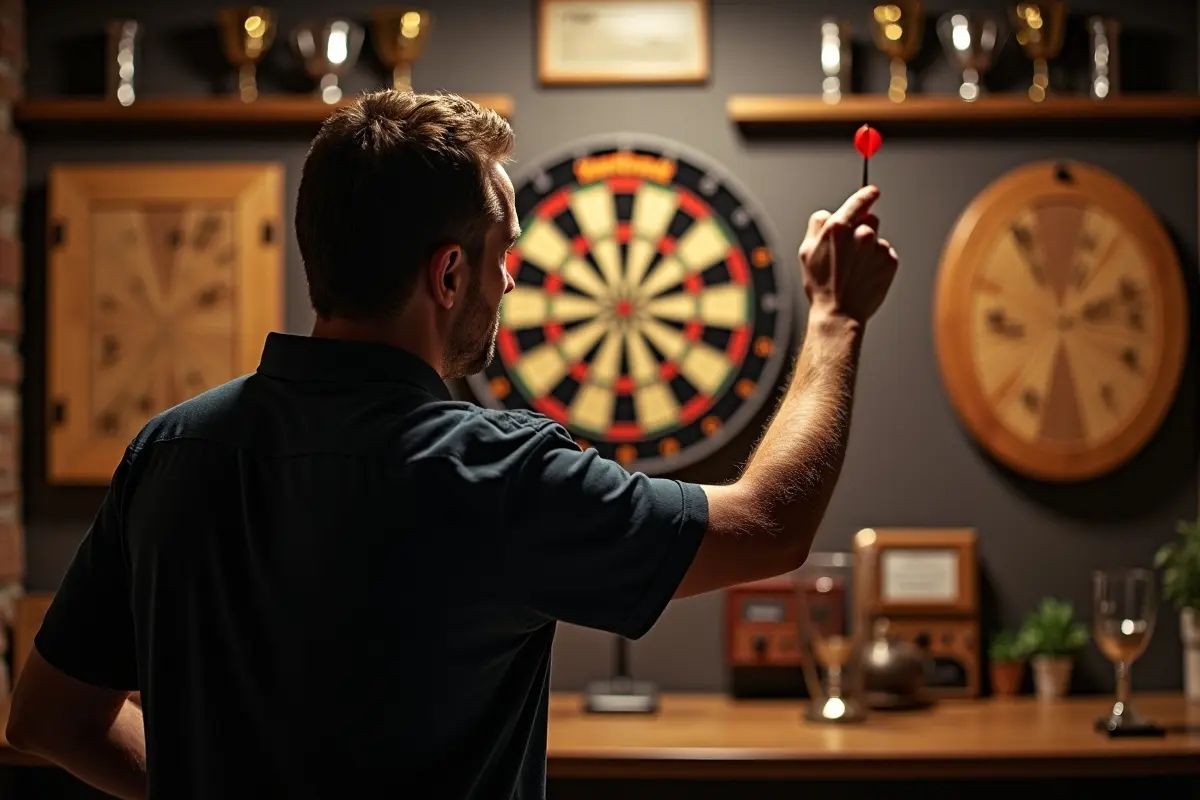
If a dartboard isn’t positioned at the perfect height, the central nerve zone won’t be where you expect it to be! That means your practice sessions aren’t helping you hit that key 60 or 57 anywhere near as much as you thought they were. Instead, you’re reinforcing muscle memory on throws that miss the board for being too low or too high.
Get The Measurements Right From The Start
The most important number to use while you’re setting up your darting sanctuary is 5 ft 8 in (173 cm). It’s the height from the floor to the center of the bullseye, and it’s the same in every PDC event you see on TV. It’s consistent across at the WDF and the BDO too. And it’s exactly right where you play in your garage. This isn’t a coincidence. The height is set at average shoulder height for a grown adult, which makes sense when you consider that dart players are between 5ft 7in and 5ft 10 in on average.
The second magical number is the oche distance, and this one’s a bit harder to accurately estimate. The front edge of the throw line is 7 ft 9.25 in (237 cm) away from the dartboard face. Note it’s the face you’re measuring from, not the wall. If your surround adds a couple of centimeters, tough – you’re measuring from the front surface of the cover, regardless of what’s behind it. The laser measures that builders love sending positive by a few degrees? Get it in the bin. A good old tape hook is accurate in the vertical and that’s what you need.
So now you know the heights – set the bullseye height first. Then, after you’ve made sure the dartboard is level, measure out from the board face to place the oche.
Make The Oche A Fixture, Not A Piece Of Tape
A strip of tape on the carpet is not an oche. It shifts, it fades, and it gives your foot nothing to actually feel. A proper throw line is raised, usually somewhere between 1.5 and 4 cm high, and that raised edge is doing more work than people realize. Your front foot finds it by touch, without you having to glance down mid-game to check your position.
This matters more than it sounds like it should. Inconsistent foot placement is one of the most common reasons casual throwers plateau. If your toe is a centimeter forward one throw and a centimeter back the next, you’re changing your effective throwing distance every single time, and your brain has to recalibrate on the fly. A permanent raised oche removes that variable completely. It costs very little to install and it’s one of the cheapest accuracy upgrades available to anyone setting up a serious throwing area.
Choose The Right Board For The Way You Actually Play
Sisal bristle boards are still considered the best when it comes to steel-tip darts, for a reason – nothing has managed to replace them since they first appeared. The compressed sisal fibers will accumulate around a dart when it’s thrown, then spread back apart to fill in the hole when the dart is pulled out. This keeps the board functional for years instead of breaking down after a few hundred throws the way paper or corkboard ones will. For longevity, the fewer parts holding down the sisal face, the better. Look for a blade wire spider rather than a stapled one. Staples causing darts to deflect are the main reason players might want to replace a board that’s stood up for years perfectly well up to that point. Don’t get a board giving you a reason to lose games on a single inch directly on a scoring line.
If you’re setting up your practice space for soft-tip instead, an electronic board for home use is completely reasonable. Especially in a common games room situation where you want score-keeping built in and less mess from bounce-outs. Know that soft-tip wire spacings might be wider as well, and you should line the area with tile to prevent as many bounce-outs. The parts to replace regularly are the tips and the actual board (soft-tips don’t last as long as sisal ones), and they’re not interchangeable with steel-tip equipment. Pick whichever format your household will actually play most often rather than trying to compromise on both.
Protect The Wall And Light The Board Properly
Once you have the board up, there are two things you want to address before people start throwing in earnest: the surround and the lighting.
A foam or engineered surround serves a dual purpose by absorbing bounce-outs so a mis-thrown dart doesn’t take a divot out of the drywall, and providing a visual buffer to extend the play area so the board isn’t sticking out like a sore thumb. You’ll be grabbing the filler and paint in no time if you skip this part.
Lighting is overlooked more often than not. Normal overhead room light creates a shadow over a portion of the board in some cases, and where that shadow lies changes based on where you’re standing at the oche. An LED ring light mounted around the board removes that dead zone completely, ensuring the numbers and wire tracks look identical whether you’re throwing high or low. Players who bemoan the fact that they were unable to “read” the triple weren’t necessarily missing the mark. They were potentially throwing at a segment that they truly couldn’t make out clearly.
Match Your Darts To Your Throw
The total weight of your darts is a personal thing. That said, there is a broad starting range. Steel-tip darts are typically between 18 and 26 grams. Lighter ones, in the 18 to 20 gram range, are for players who like to dart the wrist. Heavier ones, up towards 22 to 26 grams, are for players who make the same sort of throw but with a more languid movement that hopefully encompasses as much of the arm as possible. Lighter darts mean your throw is easier to execute, heavier ones make for a more relaxed release. A dart should never be forced.
Grip is one of the most important aspects of a good dart. Knurled barrels are easier to grip as they dig into your skin. If you have sweaty hands (as can happen after 4-5 hours down the pub) the knurling often found on a torpedo or a parallel barrel is your friend. If you have hands that are quite light or shaky on the best of occasions then a smooth or ringed barrel will have less traction. Pick something you can throw easily, not something that feels comfy for 3 minutes in a shop. Borrow a few sets from mates or a billiard shop adelaide with different weights and grip before committing yourself.
Build A Stance You Can Repeat Without Thinking
Precision in darts is achieved by minimizing as many factors as possible. The beginning of this process, and the most important variable for all players to control, is your stance. Start by placing your dominant foot at the oche, with your toe as close to the raised line as you feel comfortable. Rather than having your foot directly square on to the board, your toe should be pointing slightly towards your target. Your back foot is then there for one reason and one reason only: balance. It shouldn’t play any part in your weight transfer during the throw. It should just be there to stop you falling over sideways or forwards.
For a solid throw that sees as little body movement as necessary, the throwing is then all in the arm. Keep your upper body as still as you possibly can. This means no swaying shoulders, no rocking hips and ideally no neck movement to follow the dart. The more of your body that’s moving around, the harder it is to pinpoint exactly when to release the dart for maximum accuracy. The throw should be as repeatable as possible, with a single fluid arm movement to ensure maximum consistency.
For the majority of professional darts players, this is why they look as if they’re practically stiff as a board when they throw. It’s not tension, it’s them simply not moving if there’s no gain to precision from it!
Grip, Release, And Follow-Through
The most common grip in darts is the three-finger grip, which is relatively relaxed with the barrel resting on the fingers rather than being tightly gripped. When the barrel is gripped too tightly, it slows the release and often pulls the dart off line at the last moment.
The release should occur at the natural extension point of your arm, which is where your forearm reaches full stretch before your elbow would start to lock. Trying to release the dart early or late is one of the biggest reasons for inconsistent grouping for many players who believe they have their “style” so-to-speak down.
The follow-through is often neglected by a lot of casual throwers and it really shouldn’t be. Your throwing fingers should finish pointing directly at your target on the board, almost like you’re gesturing at where you wanted the dart to land. This won’t affect darts that have already been thrown, but performing an accurate follow-through will give other players the impression that you’ve maintained an accurate motion.
Practice Routines That Actually Build Skill
Practicing randomly won’t improve your shooting accuracy, but following a regimented practice routine certainly will. A simple but effective routine is to “round robin” 20, 19, and 18 segments. Shoot three darts at 20, then go to 19, then 18, and repeat the sequence three times. Track your hit rate on doubles. You will quickly notice whether you tend to miss low or to the side. You’ll also recognize whether you can expect to consistently hit doubles in matches when your opponent has left them without a good approach to finishing.
For doubles, practice a circuit of D1 through D20. That means shooting at double 1 three times, double 2 three times, double 3 three times and so on. Most players really only like two or three doubles, while a dozen get infrequent practice. You’ll notice your comfort level a double finishes the leg your first time playing it if you are following a sequence rather than always shooting for the same start.
Another pro tip is to practice x01 and Cricket each time you step to the line. A Cricket-like “game” reinforces the importance of closing numbers and improving your tactical finishing. Plus, practicing both formats allows you to assess your x01 proficiency under fatigue; you may be surprised how much harder it is to hit a treble after you’ve been playing for half an hour but a little work on your fitness and some training will reduce any performance drop.
Final Word
Having a dartboard hanging at the right height is the first step. But to turn a real practice area from a mere decoration on the wall, you’ll want to install an oche, invest in lighting to see better, set up a proper surround, and maybe even upgrade your darts to ones that suit your throwing action. Get those things right, develop a stance you can replicate without even considering it, and then the accuracy will come naturally.